The Sales Pressure Loop: Why Sales Performance Volatility Isn’t a Motivation Problem
Money speaks louder than words.
You can talk about culture. You can talk about engagement. You can talk about accountability and effort. But when revenue becomes volatile — when forecasts miss, when pipeline reviews feel tense, when Q4 turns into a rescue mission — the numbers are telling the real story.
And revenue rarely lies.
In many organizations, inconsistent sales performance is treated like an individual issue. A talent issue. A motivation issue. A discipline issue. So when targets are missed, leaders respond the way they’ve been taught to respond: increase pressure.
Activity expectations go up. Forecast scrutiny tightens. Pipeline reviews get longer. More dashboards. More tracking. More urgency.
For a moment, it feels productive.
But more pressure applied to a structurally strained sales system doesn’t create stability. It creates volatility.
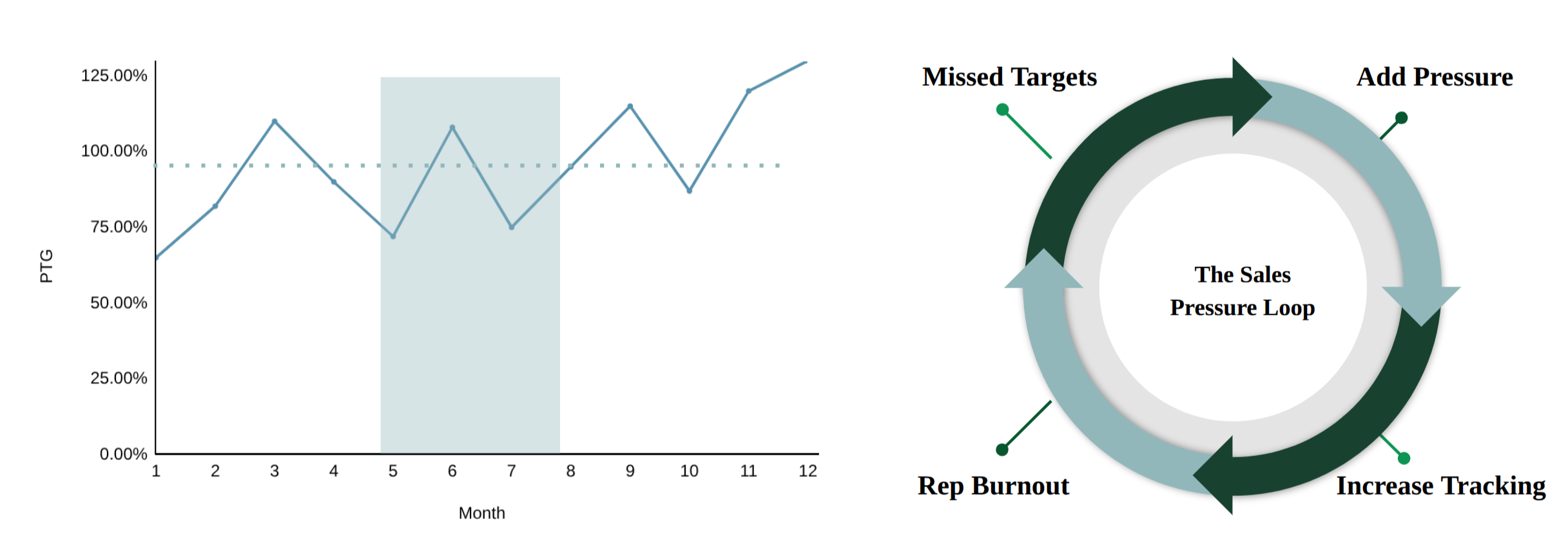
This is what I call the Sales Pressure Loop.
Targets are missed.
Pressure increases.
Activity tracking intensifies.
Reps push harder.
Burnout rises. Turnover increases.
Pipeline inflation creeps in.
Revenue fluctuates again.
And the cycle repeats.
The issue isn’t effort. In most sales organizations, effort is already high. The issue is structural friction inside the sales system itself.
When role expectations shift frequently, prioritization suffers. Reps spend time reacting instead of focusing on the highest-impact deals. When leadership behavior defaults to inspection instead of coaching, skill development stalls. When autonomy is low and micromanagement is high, adaptive selling declines — especially in complex deals.
When tools and processes create friction instead of momentum, forecast accuracy drops. CRM updates become compliance exercises rather than strategic tools. Deals bunch at the end of the quarter. Revenue spikes and dips.
And leaders respond with more pressure.
Money speaks louder than words. Revenue volatility is one of the clearest indicators that something in the sales system isn’t aligned.
If sales performance feels inconsistent, if quota attainment swings dramatically month to month, if forecast accuracy feels unpredictable, those are not random events. They are patterns. And patterns point to the system.
Sales performance is not driven by pressure alone. It’s shaped by leadership behaviors, clarity of expectations, autonomy within guardrails, enablement systems, and execution discipline. When those organizational systems are strong, revenue stabilizes. When they’re misaligned, no amount of pressure will fix it.
You can’t pressure your way out of systemic friction.
The real question isn’t, “Why aren’t they working harder?”
It’s, “What in our sales system is shaping this behavior?”
Because while culture conversations are important, and engagement matters, in the end money speaks louder than words. And revenue patterns will always reveal what the system actually supports.
If performance volatility keeps repeating, it may be time to stop increasing pressure — and start diagnosing the system.